
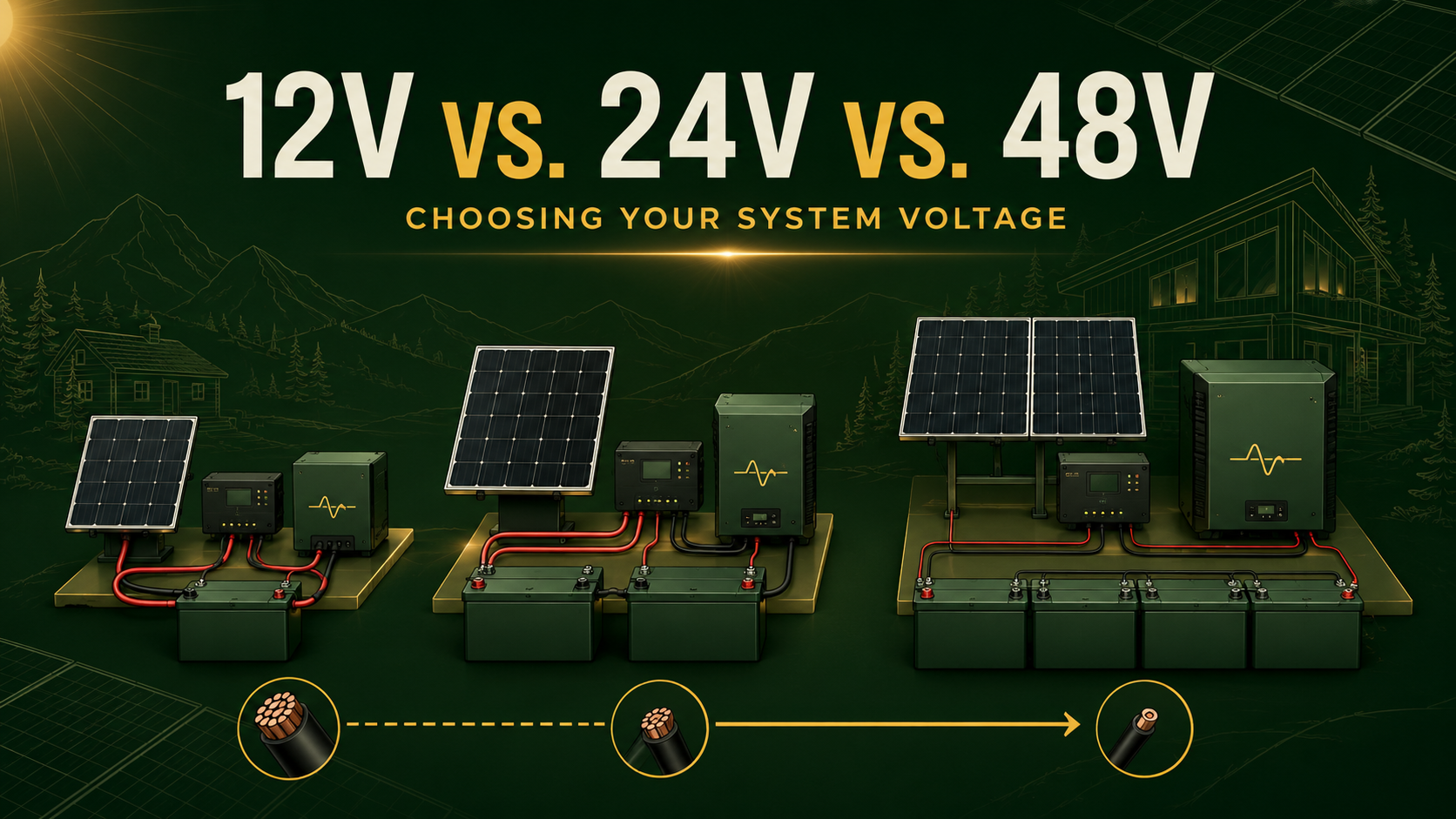
When comparing a 12V vs. 24V vs. 48V solar system, the main question is how much power the battery bank must deliver. As power increases, a higher battery voltage reduces current, voltage drop, conductor size and stress on the DC equipment.
As a practical starting point:
- 12V systems are best suited to vehicles, boats and small installations with modest inverter loads.
- 24V systems work well for medium-sized cabins, mobile systems and installations that have outgrown practical 12V current levels.
- 48V systems are generally the best choice for larger cabins, homes and systems using several thousand watts of inverter capacity.
These are guidelines, not absolute boundaries. Equipment availability, existing DC loads, expansion plans and manufacturer requirements can shift the decision.
The number of solar panels and the amount of energy storage required do not inherently increase when you choose a higher battery voltage. A 10 kWh battery bank stores approximately the same amount of energy whether configured for 12V, 24V or 48V. What changes is the relationship between voltage, amp-hours and current.
Three Different Voltages in an Off-Grid Solar System
“Solar-system voltage” can refer to several different things. Keeping them separate prevents a great deal of confusion.
The battery-bank voltage—commonly 12V, 24V or 48V—is the nominal DC system voltage discussed in this article.
The inverter’s DC input must be compatible with this voltage. A 48V inverter requires a compatible 48V battery bank; it cannot be connected directly to a 12V battery.
Solar-Array Voltage
The PV array has its own operating voltage, determined by the solar modules and their series-parallel configuration.
With a compatible MPPT charge controller, the array voltage is commonly higher than the battery voltage. The controller converts the array’s higher-voltage, lower-current output into the voltage and current required to charge the battery.
A 48V PV array and a 48V battery bank are therefore not necessarily the same thing. In fact, a PV array charging a nominal 48V battery must operate above the battery’s actual charging voltage.
AC Output Voltage
The inverter converts battery power into AC power for household equipment. In North America, that output may be 120V or 120/240V split phase.
Changing from a 24V to a 48V battery bank does not mean the receptacles suddenly receive 48V. The battery voltage is on the DC side of the inverter; the inverter produces the required AC output voltage.
Why Higher Battery Voltage Reduces Current
The basic relationship is:
Current = Power ÷ Voltage
For an inverter supplying the same power, doubling the battery voltage cuts the approximate DC current in half.
In actual operation, inverter efficiency must also be considered:
DC current = AC output power ÷ (battery voltage × inverter efficiency)
Consider a 3,000-watt AC load and an inverter operating at 92% efficiency:
| Nominal battery voltage | Approximate DC current |
|---|---|
| 12V | 272A |
| 24V | 136A |
| 48V | 68A |
These are simplified planning values. Actual current changes with battery voltage, inverter efficiency and operating conditions.
The comparison nevertheless shows why system voltage matters. Supplying 3,000 watts from a nominal 12V bank requires roughly four times the current required from a 48V bank.
Higher current generally means:
- Larger battery conductors
- Larger fuses, breakers, switches and busbars
- Greater voltage drop
- More heat produced by resistance
- More demanding battery and BMS discharge-current requirements
- More challenging terminations and current sharing
Resistive conductor loss is proportional to current squared. If the same conductor resistance were used, reducing current by a factor of four would reduce conductor heating loss by a factor of sixteen.
Higher voltage does not eliminate the need for properly sized conductors, overcurrent protection and tight connections. It simply makes high-power DC distribution more manageable.
When a 12V Solar System Makes Sense
A 12V system remains an excellent choice when its capabilities match the application. It is especially common in:
- Cars, vans and recreational vehicles
- Boats and marine systems
- Small cabins and sheds
- Communications and monitoring systems
- Systems with numerous native 12V loads
- Installations using a relatively small inverter
One major advantage is equipment availability. Automotive, marine and RV markets offer an extensive selection of 12V lighting, pumps, refrigerators, controls and accessories.
A 12V system can also integrate naturally with a vehicle starter battery or alternator, although an appropriate isolator or DC-to-DC charger may be required.
Limitations of 12V Systems
The disadvantage appears as inverter power increases. Even a 2,000-watt AC load can require approximately 181 amps from a 12V battery when inverter efficiency is 92%.
At those current levels, conductor sizing, voltage drop, fusing, terminations and battery discharge capability become significant design constraints.
Parallel batteries can increase storage capacity and available current, but they must be connected in a manner that promotes balanced current sharing. The battery manufacturer must also permit the proposed number of parallel units.
Adding batteries in parallel does not increase system voltage. It increases amp-hour capacity and potentially the available discharge current while the bank remains nominally 12V.
A 12V system is therefore most attractive when:
- Inverter demand is modest
- DC cable runs are short
- Native 12V loads are important
- Compatible equipment is already installed
- Large future expansion is unlikely
If the design requires several thousand watts of inverter output, moving to 24V or 48V will usually produce a cleaner and more practical system than continuing to add parallel 12V capacity.
When a 24V Solar System Makes Sense
A 24V system occupies the useful middle ground between compact 12V installations and larger 48V systems.
It is commonly used for:
- Medium-sized cabins and tiny homes
- Larger RV, marine and mobile systems
- Telecommunications and remote monitoring equipment
- Systems using approximately 1,500 to 4,000 watts of inverter capacity
- Installations with moderate DC cable lengths
- Existing equipment designed around 24V power
Those inverter ranges are planning guidelines rather than electrical limits. The actual choice depends on DC current, cable length, battery capability and available equipment.
For the same power, a 24V system draws approximately half the current of a 12V system. At 3,000 watts and 92% inverter efficiency, the approximate current decreases from 272 amps at 12V to 136 amps at 24V.
That reduction can make conductors, overcurrent protection, busbars and disconnecting equipment considerably more manageable.
Advantages of a 24V Systems
A 24V system can provide a useful balance of performance and equipment availability:
- Lower current than an equivalent 12V system
- Reduced voltage drop for a given conductor
- Smaller conductors than an equivalent 12V design
- Compatibility with many medium-sized inverters and charge controllers
- Lower current demand from each properly configured battery string
- Support for substantial loads without immediately moving to 48V
Native 24V lighting, pumps and controls are available, particularly in marine, trucking, telecommunications and industrial markets.
When 12V loads are required, a properly sized 24V-to-12V DC-to-DC converter can serve them without forcing the entire energy system to operate at 12V.
Limitations of a 24V System
Twenty-four volts is less standardized than 12V in vehicles and less common than 48V in modern residential energy-storage equipment. Depending on the application, product selection may be narrower.
A 24V bank can be created using a native 24V battery or compatible lower-voltage batteries connected in series. Not every lithium battery permits series connection, so this must be confirmed in the manufacturer’s instructions.
Never power a 12V load by connecting it across only one battery in a 24V series string. Doing so creates unequal loading and can unbalance the bank. Use a compatible DC-to-DC converter instead.
A 24V system may also become cumbersome when continuous inverter demand approaches several thousand watts. At 5,000 watts and 92% efficiency, a 24V bank would supply approximately:
5,000 W ÷ (24 V × 0.92) = approximately 226 amps
At that level, a 48V system deserves serious consideration.
When a 48V Solar System Makes Sense
A 48V battery system is generally the most practical choice for high-power off-grid installations.
Common applications include:
- Full-time off-grid homes
- Larger cabins and workshops
- Systems with 3,000-watt or larger inverters
- Installations serving pumps, HVAC equipment or substantial kitchen loads
- Systems designed for future expansion
- Equipment platforms built around nominal 48V batteries
Modern “48V” lithium iron phosphate batteries are commonly rated at 51.2V nominal. Their actual voltage changes with state of charge and may rise well above 48V while charging. Every inverter, charger, controller, disconnect and protective device must be rated for the battery’s complete operating-voltage range.
Advantages of a 48V System
The primary advantage is lower current.
At 5,000 watts and 92% inverter efficiency, a nominal 48V battery supplies approximately:
5,000 W ÷ (48 V × 0.92) = approximately 113 amps
That is half the approximate current required at 24V and one-quarter of what would be required at 12V.
Lower current can provide:
- More manageable conductor sizes
- Reduced conductor voltage drop
- Lower resistive losses
- Less demanding current ratings for switches and busbars
- Better compatibility with high-power inverters
- More practical expansion to larger AC loads
- Lower current demand per kilowatt of inverter output
A 48V system does not automatically require more solar panels or more stored energy. Those quantities are established by the load calculation, desired autonomy and available solar resource.
For example, these battery banks all store approximately 5.12 kWh:
- 12.8V × 400Ah = 5.12 kWh
- 25.6V × 200Ah = 5.12 kWh
- 51.2V × 100Ah = 5.12 kWh
The voltage and amp-hour ratings differ, but the stored energy is approximately equal.
Limitations of a 48V System
Higher voltage does not mean a system is automatically safer, cheaper or easier to install.
Potential limitations include:
- Fewer appliances designed to operate directly from nominal 48V
- Need for DC-to-DC converters when serving 12V or 24V loads
- Equipment that must be rated for the battery’s maximum charging voltage
- Greater consequences from improper wiring or accidental short circuits
- More specialized installation and troubleshooting knowledge
- Possible incompatibility with existing lower-voltage equipment
Although nominal 48V systems are commonly described as low voltage, their operating and charging voltages can approach or exceed thresholds used in various equipment and safety requirements. Treat the battery bank as a high-energy electrical source capable of delivering extremely large fault current.
Proper overcurrent protection, disconnects, conductor sizing, enclosures and manufacturer-approved components remain essential.
12V vs. 24V vs. 48V: Quick Comparison
| Consideration | 12V | 24V | 48V |
|---|---|---|---|
| Best fit | Small and mobile systems | Medium-sized systems | Homes and high-power systems |
| DC current for the same power | Highest | Moderate | Lowest |
| Native DC appliance availability | Excellent | Moderate | Limited |
| High-power inverter practicality | Limited | Moderate | Best |
| Typical conductor demand | Largest | Smaller | Smallest |
| Compatibility with vehicle systems | Excellent | Application-dependent | Limited |
| Expansion to large loads | Least flexible | Moderately flexible | Most flexible |
| Need for DC-to-DC conversion | Less likely | Common for 12V loads | Common for 12V and 24V loads |
A Practical Voltage-Selection Method
Use this process rather than selecting voltage solely from system size labels:
1. Calculate Maximum Inverter Demand
Determine the maximum simultaneous AC load and required motor-starting surge using the method in our inverter-sizing guide.
2. Calculate Approximate DC Current
Use:
DC current = inverter output watts ÷ (nominal battery voltage × inverter efficiency)
Run the calculation at 12V, 24V and 48V.
3. Evaluate the Current
If the calculated current requires impractically large conductors, exceeds battery or BMS limits, or creates excessive voltage drop, move to a higher system voltage.
As a practical design signal, sustained inverter current approaching or exceeding roughly 150 to 200 amps deserves careful scrutiny. This is not an absolute prohibition, but higher voltage often produces a better design.
4. Check Available Equipment
Confirm that suitable batteries, inverters, charge controllers, DC-to-DC converters and protective devices are available at the proposed voltage.
5. Consider Existing DC Loads
A vehicle filled with native 12V equipment may justify retaining 12V. A house that distributes power primarily as 120/240V AC has much less reason to keep the battery bank at 12V.
6. Plan for Realistic Expansion
If substantial future loads are likely, moving to a higher voltage now may prevent replacement of the inverter, battery configuration, conductors and protective equipment later.
Do not select 48V merely because it is bigger. Select it when the power level and current calculation demonstrate that it provides a more practical system.
Series, Parallel and Series-Parallel Battery Banks
Battery configuration determines the voltage and amp-hour capacity of a bank.
Batteries Connected in Series
Series connections increase voltage while amp-hour capacity remains the same.
For example, four compatible 12.8V, 100Ah batteries connected in series create an approximately:
51.2V, 100Ah battery bank
Its nominal stored energy is:
51.2V × 100Ah = 5.12 kWh
Every battery in the series string carries the same current. Differences in capacity, state of charge, internal resistance or battery-management-system behavior can therefore affect the entire string.
Not every lithium battery may be connected in series. Confirm the permitted series configuration in the manufacturer’s instructions.
Batteries Connected in Parallel
Parallel connections maintain voltage while increasing amp-hour capacity and potentially available discharge current.
Four compatible 12.8V, 100Ah batteries connected in parallel create an approximately:
12.8V, 400Ah battery bank
Its nominal stored energy is also:
12.8V × 400Ah = 5.12 kWh
Parallel batteries should be connected so that each unit experiences similar conductor resistance. Unequal cable lengths or poorly arranged connection points can cause some batteries to supply more current than others.
Manufacturers may limit the number of batteries allowed in parallel.
Series-Parallel Battery Banks
A series-parallel configuration uses multiple series strings connected in parallel. This can increase both bank voltage and amp-hour capacity.
These arrangements require careful conductor routing, string protection and current balancing. Native 24V or 48V battery modules can simplify a larger system by reducing the number of series and parallel interconnections.
Never combine batteries of different models, capacities, chemistries, ages or states of health unless the manufacturer specifically approves the arrangement.
Match Every Component to the System Voltage
Choosing a battery voltage affects more than the battery itself. Verify compatibility across the complete DC system.
Inverter
The inverter’s nominal DC input must match the battery bank. Its complete operating-voltage range must also include the battery’s maximum charging voltage and expected low-voltage operating range.
Battery Charger and Inverter/Charger
Any AC-powered battery charger must support the selected battery voltage and chemistry. Charging-voltage settings and current limits must comply with the battery manufacturer’s requirements.
Solar Charge Controller
The controller must support both:
- The PV array’s voltage and current
- The battery bank’s voltage and required charging profile
The array’s cold-weather open-circuit voltage must remain below the controller’s maximum PV input rating. Its operating voltage must also remain within the controller’s MPPT range.
Controller output current generally increases as battery voltage decreases. Approximately 2,400 watts of charging power could represent roughly 200 amps at 12V, 100 amps at 24V or 50 amps at 48V before accounting for actual charging voltage and losses.
A higher-voltage battery bank can therefore reduce the number or output-current rating of charge controllers needed for a large array.
Batteries and Battery-Management System
Confirm:
- Permitted system voltage
- Maximum series and parallel configuration
- Continuous charge-current limit
- Continuous discharge-current limit
- Peak discharge capability and duration
- Required communications with the inverter or charger
- Low- and high-temperature operating limits
DC Distribution Equipment
Busbars, switches, fuses, circuit breakers, shunts and disconnects must be rated for the maximum system voltage and available fault current.
A device with an adequate current rating may still be unsuitable if its DC voltage rating is too low. DC interruption is more demanding than AC interruption, so use equipment specifically rated for the application.
DC Loads
Directly connected DC equipment must tolerate the battery bank’s full operating-voltage range—not merely its nominal voltage.
A nominal 12V lithium battery, for example, does not remain at exactly 12 volts. Sensitive equipment may require a regulated DC-to-DC converter even when its labeled voltage appears to match the battery.
What About Solar-Panel Voltage?
Battery voltage does not dictate a single required solar-panel voltage.
Modern MPPT charge controllers often use solar arrays with operating voltages substantially higher than the battery bank. Connecting modules in series raises array voltage and reduces array current, which can improve PV-circuit conductor requirements over longer distances.
However, the array configuration must remain within all charge-controller limits:
- Maximum cold-weather open-circuit voltage
- MPPT operating-voltage range
- Maximum input current
- Maximum short-circuit current
- Maximum permitted PV power
- Connector and conductor ratings
Do not select the array voltage merely by labeling it “12V,” “24V” or “48V.” Use the module specifications, site temperature and charge-controller requirements to determine an electrically compatible series-parallel configuration.
Three Example Voltage Decisions
Example 1: Small Van With an 800W Inverter
At 800 watts and 92% inverter efficiency, a 12V system would draw approximately:
800 W ÷ (12 V × 0.92) = 72 amps
With short, properly sized conductors and numerous existing 12V loads, remaining at 12V may be perfectly reasonable.
Example 2: Cabin With a 2,500W Inverter
At 12V:
2,500 W ÷ (12 V × 0.92) = 226 amps
At 24V:
2,500 W ÷ (24 V × 0.92) = 113 amps
The 24V design substantially reduces current while avoiding the transition to 48V equipment. It may be the most practical choice if compatible batteries and an inverter are readily available.
A 48V system could also work, particularly if significant expansion is expected.
Example 3: Off-Grid Home With a 6,000W Inverter
At 24V:
6,000 W ÷ (24 V × 0.92) = 272 amps
At 48V:
6,000 W ÷ (48 V × 0.92) = 136 amps
For this application, 48V is generally the more practical starting point. The lower current simplifies the high-power DC path and aligns with many residential off-grid inverters and battery systems.
Solar-System Voltage Selection Checklist
Before choosing 12V, 24V or 48V, determine:
- Maximum continuous inverter output
- Required inverter surge power
- Approximate DC current at maximum output
- Battery and BMS discharge limits
- Required battery storage capacity
- Battery manufacturer’s series and parallel limits
- Maximum charge-controller output current
- Existing native DC loads
- Need for DC-to-DC converters
- Required 120V or 120/240V AC output
- Conductor length and acceptable voltage drop
- Ratings of fuses, breakers, switches and busbars
- Alternator, generator or shore-power charging requirements
- Realistic future expansion plans
System voltage is a design decision, not a measure of system quality. A well-designed 12V system is better than a poorly coordinated 48V system.
Frequently Asked Questions
Is a 48V solar system more efficient than a 12V system?
A 48V battery system uses one-quarter of the current required by a 12V system to deliver the same power. This can reduce conductor voltage drop and resistive losses. Overall system efficiency still depends on the inverter, charge controller, conductors, connections and operating conditions.
Does a 48V system require more solar panels?
No. Solar-array size is based on daily energy consumption, solar resource, losses and design margin. Battery-bank voltage does not inherently change the required array wattage.
Does a 48V battery store more energy than a 12V battery?
Not necessarily. Stored energy is calculated in watt-hours:
Watt-hours = volts × amp-hours
A 12.8V, 400Ah bank and a 51.2V, 100Ah bank both store approximately 5.12 kWh.
Can I connect four 12V batteries to make 48V?
Only if the batteries are compatible with series operation and the manufacturer permits four units in series. Confirm the battery specifications before purchasing or connecting them.
Can I run a 12V appliance from one battery in a 48V series bank?
No. Tapping one battery creates unequal loading and can unbalance the bank. Use a properly sized 48V-to-12V DC-to-DC converter.
Can a higher-voltage solar array charge a lower-voltage battery?
Yes, when a compatible MPPT charge controller is used. The controller must support the array’s maximum voltage, current and power as well as the battery’s voltage and charging requirements.
Should I choose 24V or go directly to 48V?
Calculate the maximum inverter current at both voltages and compare equipment availability, DC loads and expansion plans. A 24V system may be practical for a medium-sized cabin or mobile installation. For a larger home or several thousand watts of sustained inverter demand, 48V is often the stronger long-term choice.
Design the Complete System
Battery voltage must coordinate with the inverter, solar array, charge controller, battery-management system and DC distribution equipment.
The Evergreen Off-Grid System Designer evaluates your loads and location, recommends a system voltage and develops a coordinated preliminary design for the solar array, battery bank, inverter and charge-control equipment.
Final Takeaway
Choose system voltage from the power the battery must deliver—not from slogans about one voltage being universally better.
Twelve volts remains useful for small systems and native automotive or marine loads. Twenty-four volts offers a practical middle ground. Forty-eight volts makes high-power off-grid systems more manageable by reducing current.
Run the numbers before buying equipment. The right voltage is the one that supports your loads, keeps DC current practical and allows every component to work together without requiring battery cables that look like they belong on a tugboat.