
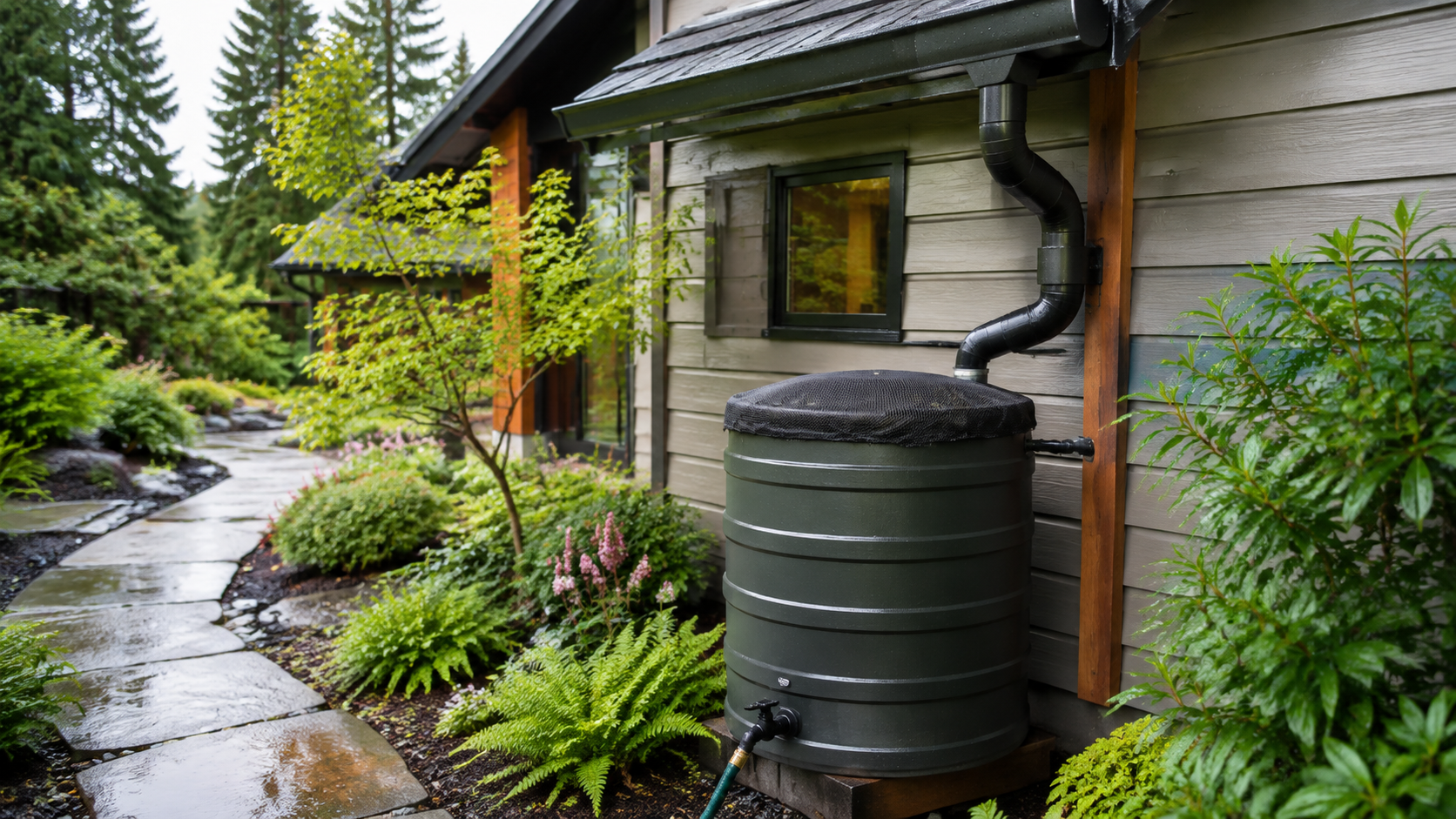
Is it illegal to collect rainwater from your own roof? The short answer is generally no—but state and local rules can affect how much water you may collect and how you may use it.
So why do so many people believe rainwater harvesting is illegal? To answer that, we’ll travel back to the California Gold Rush, explore the origins of Western water law and investigate the Oregon man who really did go to jail in a case involving “collected rainwater.”
Spoiler: He wasn’t arrested for putting a rain barrel beneath his downspout.
Why Do People Think Collecting Rainwater Is Illegal?
There’s a chance you found this page by googling some variation of the following question: “Is it legal to collect rainwater?”
Surprisingly, this is one of the most common questions I get when I talk about rainwater harvesting. Somehow, it has become enshrined in urban myth that it is illegal to collect rainwater on your own property. Not just against the law. But you can actually go to jail for collecting rain off your own roof… or so the myth goes.
You’ve Got to Be Joking??!
How absurd! Things have gotten out of control if people are going to jail for collecting rain.
I would have just dismissed the question if I hadn’t heard it several times. But also, deep down I felt some subconscious familiarity with this story. When asked if water collection was legal, I’ve had to tell them… I don’t know it’s legal, but I know it’s legal… uh, I’ll get back to you. Well, consider this me getting back to you.
One thing I did know for sure was that people were harvesting rainwater from their rooftops. That much we can figure out just by looking around our neighborhoods and seeing rain barrels connected to downspouts. So, either we have a prolific eco-terrorism problem, or… ok, to be less dramatic… Either we have a bunch of folks unknowingly breaking the law, or there is something else responsible for this common misconception.
To fully grasp our relationship with water rights in America let’s go back to the beginning. Our collective social and legal disagreements over a person’s rights when it comes to water usage began out West. Back East, rainfall was plenty and competition over water was generally less intense. But in the unfamiliar and arid conditions out West, the debate over who owns water would begin. Let’s head back to the California Gold Rush in the mid-1800s.
Note: As an affiliate, I earn from qualifying purchases.
5 High Capacity Emergency Survival Water Straws
$39.98
Redmoon 4Pcs 5L Collapsible Water Container
$18.99
READY FOR ANYTHING: PRACTICAL STRATEGIES FOR SURVIVING DISASTERS AND EMERGENCIES
$15.99
Gold Rush
Imagine being in the Sierra Nevada Mountains in California. The year is 1855. After barely surviving a treacherous journey across the vast interior of the United States a few years back, you’ve been working claims in these mountains, hoping each new day will be the day you strike it rich.
You’ve learned that finding gold in these hills requires massive amounts of water. You wash through mountains of material using the fire hose nature has so conveniently set here, seemingly just for you. Your heart beats a little faster every time a glint of light dances off the rocky stream bed. Your entire focus in this pristine, beautiful landscape is on spotting tiny flakes of metal. Those lucky souls that happen to be looking for needles in haystacks are the stuff of envy.
Prior Appropriation
One morning you wake up to a glorious sunshine. You sit down to a plate of gritty, flavorless pancakes. The pancakes are washed down with some chewy cowboy coffee. Coffee that has the consistency of the sand you discard from your pan.
When you’re finished eating, you head over to your claim to put in a day’s work and notice that the stream you were using to separate gold from soil has slowed to a trickle. You investigate. After traveling upstream a ways, you discover the cause of your plumbing issues. Another miner has diverted YOUR water source to help him with HIS claim!
Who Owns the Water? First Come First Served.
This can’t be! You can’t take my stream! Well, it turns out he can if he was using the resource first. In early Gold-Rush era California, there was no Government capable of exercising any real authority. Justice was often the ruthless sort which is dished out beyond the reach of the law. But in a way, this type of justice settled the law. It became the law. In this case the “law” was settled in favor of first come, first served principles.
Law out West, or anywhere for that matter, was basically a set of agreed upon rules. And in this case, it was generally agreed upon that a miner was allowed to divert water away from its source to support mining operations elsewhere. Back then, this wasn’t seen as destructive. It was seen as progressive.
Note: As an affiliate, I earn from qualifying purchases.

Anker SOLIX F2000 Portable Power Station with Solar Panels
$2,899.00 Original price was: $2,899.00.$1,499.99Current price is: $1,499.99.

Emergency Radio with NOAA Weather Alert, Portable Solar Hand Crank AM FM Shortwave Radio for Survival
$59.99 Original price was: $59.99.$32.39Current price is: $32.39.
In 1855, the Supreme Court of the State of California upheld these established mining traditions with their decision in Irwin v. Phillips. A reading of the ruling leaves you feeling like the justices were not fully convinced of the justice they were dispensing. But, having limited options and even less precedent they threaded the needle of justice, attempting to stitch together the fabric of old common law with the realities of these gold mining communities. Peace – and, more importantly, progress was priority.
The dispute unfolded on federal public land. Neither side held conventional private ownership of the stream or surrounding mining claims. Instead, miners occupied the land with the federal government’s general acquiescence, leaving California courts to resolve conflicts using the customs that had developed within the mining communities.
In Irwin v. Phillips, the California Supreme Court upheld the rights of the person who had first diverted and used the water. That decision helped establish the doctrine of prior appropriation—the Western water-law principle commonly summarized as “first in time, first in right.”
Beneficial Use
Once a person establishes a right to a water resource, that right generally depends on putting the water to “beneficial use.” Depending on the jurisdiction, recognized uses may include household consumption, agriculture, industry, recreation or electricity generation.
The earliest valid claimant traditionally holds the “senior” water right, while later claimants hold “junior” rights. During a shortage, junior users generally cannot interfere with the senior user’s established right—another expression of “first in time, first in right.”
Some Theories
The “rationale” some people use when theorizing why the government would make rain harvesting illegal is as interesting as it is varied.
One theory is that rain falling on your roof would otherwise flow into streams, rivers or aquifers, where someone downstream may hold an established right to use it. That concern is not completely imaginary—Western water law really does protect senior water rights—but a household rain barrel is a very different thing from diverting an entire stream.
The explanation sounds so awfully, bureaucratically perfect that I almost want the urban legend to be true. In practice, rooftop rainwater collection is broadly allowed, although some states and local jurisdictions regulate the amount collected, the type of system or how the water may be used.
Others have far more nefarious theories. The most obvious being that the government doesn’t want you to collect water because they want to control you. They want to control the water taps themselves, so to speak. To that I say, eh, maybe. I don’t buy it, but I bet I won’t convince you.
But Didn’t Some Dude Go to Jail?
Yes. A man in Oregon really did serve jail time in a case involving rainwater—which explains why this myth refuses to die.
Sensational headlines described Gary Harrington as a homeowner jailed merely for collecting rainwater on his own property. Outrageous! How can Oregon politicians sleep at night knowing an innocent man was imprisoned for placing a rain barrel beneath his downspout?
Well, that isn’t what happened.
Harrington constructed three dams—one reportedly about 15 feet high—and used them to maintain large reservoirs holding nearly 13 million gallons of water. The dams intercepted water flowing toward a nearby creek, and the reservoirs included boats, docks and fish stocked for recreational use.
He also lacked the required water-right permits and continued maintaining the reservoirs after years of warnings and legal disputes. In 2012, he was sentenced to 30 days in jail and fined $1,500.
So yes, “some dude in Oregon” went to jail in a case involving collected rainwater. But he wasn’t arrested for watering his tomatoes from a barrel. He had effectively created his own private lake district.
So, Is It Legal to Collect Rainwater?
Generally, yes. Collecting rainwater from your roof is legal throughout much of the United States, and many states actively encourage it. There is no general federal prohibition against residential rainwater harvesting, but state and local requirements vary.
Some jurisdictions limit storage capacity or restrict how collected water may be used. Using it for irrigation is typically simpler than using it inside a home, where plumbing codes, treatment requirements or permits may apply. Large systems and anything that alters a natural stream or drainage channel can face very different rules.
In other words, a rain barrel beneath your downspout is not the same thing as building a private 13-million-gallon fishing reservoir. Before installing a system, check the current requirements for your state, county and city.
Check Your State: Federal Energy Management Program Rainwater Harvesting Map
Is Rainwater Harvesting Good for the Environment?
Generally, yes. Roofs, driveways and other hard surfaces prevent rain from soaking naturally into the ground. Instead, the water runs quickly into streets and storm drains, carrying soil, fertilizer, oil and other pollutants toward local waterways.
Rain barrels and larger collection systems capture some of that runoff before it leaves the property. The stored water can later be used for landscaping when the soil is dry and better able to absorb it. This can reduce demand for treated drinking water while slowing the rush of stormwater during heavy rain.
One household rain barrel will not single-handedly prevent the next flood. But across a neighborhood, rainwater collection—combined with rain gardens, permeable surfaces and thoughtful drainage—can make a meaningful difference.
Start Collecting Rainwater
Rainwater collection is generally legal, environmentally beneficial and surprisingly easy to begin. A basic rain barrel connected to a downspout can provide water for gardens and landscaping while reducing stormwater runoff.
Just check your state and local requirements before getting started—especially if you plan to install a large system, connect it to household plumbing or use the water for drinking.
And remember: rain barrel, yes. Thirteen-million-gallon private fishing reservoir, maybe ask first.