
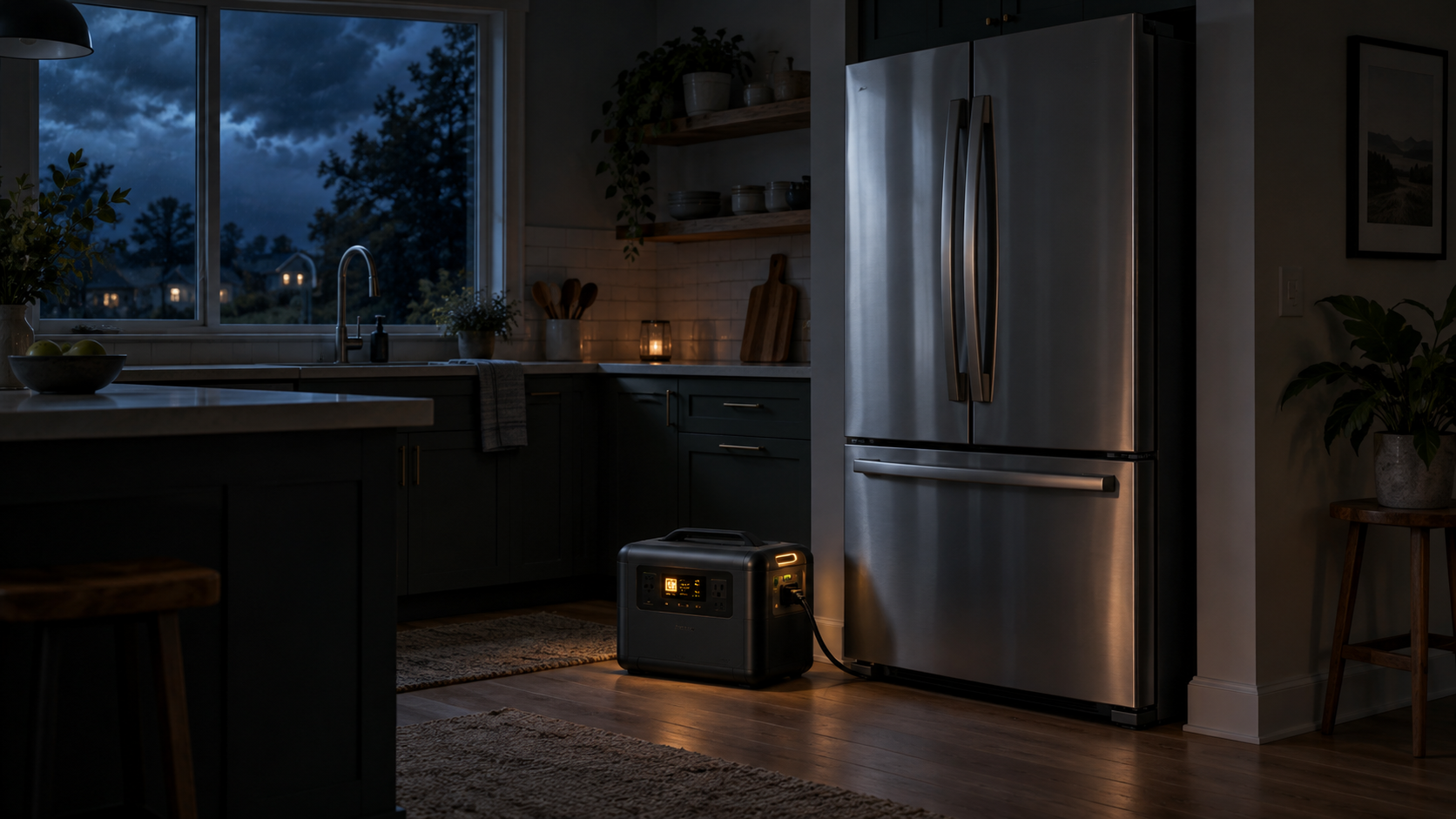
When the power goes out, your phone can wait. Your refrigerator cannot—at least not for long.
The U.S. Food and Drug Administration says an unopened refrigerator will keep food cold for about four hours during an outage. After that, keeping food at a safe temperature requires another source of cooling or power. A portable power station can provide that bridge without the engine noise, fuel storage, or combustion exhaust of a gas generator.
But what size power station do you actually need?
For a refrigerator rated at 500 kilowatt-hours (kWh) per year, a power station with about 2,000 watt-hours (Wh) of capacity is a reasonable planning starting point for approximately 24 hours of refrigerator-only backup. A 1,000Wh unit would provide roughly 13 hours under the same assumptions.
That is only half of the answer, though. The power station must also have enough output to start the refrigerator’s compressor. Battery capacity determines how long the refrigerator can run; inverter output and surge capability determine whether it can start at all.
This guide will show you how to check both.
Quick answer: Find your refrigerator’s annual kWh rating, convert it to daily watt-hours, account for power-station losses, and then verify the compressor’s starting requirement against the station’s surge rating. Do not choose a unit from battery capacity alone.
As an Amazon Associate, Evergreen Off-Grid earns from qualifying purchases.
Refrigerator Backup Size: A Quick Planning Table
The table below shows how the refrigerator’s annual EnergyGuide rating changes the required power-station capacity. These are example energy-use levels—not promises about any particular refrigerator.
| Refrigerator Energy Use | Daily Refrigerator Load | Power Station for 12 Hours | Power Station for 24 Hours |
|---|---|---|---|
| 300 kWh/year | About 820Wh/day | About 550Wh | About 1,105Wh |
| 500 kWh/year | About 1,370Wh/day | About 920Wh | About 1,845Wh |
| 700 kWh/year | About 1,920Wh/day | About 1,290Wh | About 2,580Wh |
These estimates assume:
95% usable battery capacity
90% AC conversion efficiency
A 15% energy reserve for real-world conditions
No other equipment connected to the power station
Your refrigerator may use more or less energy depending on its size, age, temperature setting, room temperature, door openings, defrost cycle, ice maker, condition, and how full it is. Use the table to identify a general capacity class, then calculate with your refrigerator’s information.
Watts, Watt-Hours, and Starting Surge
Portable power-station specifications throw several similar-looking numbers at you. Three of them matter most when powering a refrigerator.
Watt-Hours Determine Runtime
Watt-hours measure stored energy. Think of watt-hours as the size of the power station’s fuel tank.
A 2,000Wh power station holds approximately twice as much energy as a 1,000Wh power station. That does not always mean exactly twice the usable runtime because conversion losses, standby consumption, temperature, and battery-management limits also matter. But watt-hours are the right starting point for estimating how long your refrigerator can operate.
Continuous Watts Determine Running Capability
Watts measure how quickly the station can deliver energy. If watt-hours are the tank, watts are the size of the pipe leaving it.
The power station’s continuous AC output must exceed the refrigerator’s running demand—plus anything else you intend to power at the same time.
Surge Watts Determine Starting Capability
A refrigerator compressor can briefly demand substantially more power while starting than it uses after it is running. If that momentary demand exceeds the power station’s surge capability, the inverter may shut down even when the battery is fully charged.
This is why a giant battery does not automatically make a power station refrigerator-compatible. It needs both adequate energy capacity and adequate output.
How to Find Your Refrigerator’s Energy Use
Do not begin with a generic internet estimate if information for your actual refrigerator is available. Use one of these methods, listed from easiest to most accurate for planning.
1. Read the EnergyGuide Label
The yellow EnergyGuide label lists the refrigerator’s estimated annual energy consumption in kWh. According to the Federal Trade Commission, these figures are based on Department of Energy test procedures and are intended to help consumers compare similar appliances.
If the original label is gone, search the refrigerator’s model number on the manufacturer’s website or an appliance retailer’s product page.
Convert annual energy use to daily watt-hours with this formula:
Daily Wh = Annual kWh × 1,000 ÷ 365
For a refrigerator rated at 500 kWh per year:
500 kWh × 1,000 ÷ 365 = 1,370Wh per day
The EnergyGuide value is a standardized estimate, not a guarantee. Your real consumption can be higher during hot weather, frequent door openings, or a long compressor run after the refrigerator has warmed.
2. Measure It With a Plug-In Energy Meter
A plug-in energy meter can measure how much energy your refrigerator actually consumes. For a useful result, measure cumulative kWh for at least 24 hours; 48 to 72 hours is better because it captures more compressor and defrost cycles.
Measure the refrigerator while it is already cold and operating normally if that represents your expected outage condition. If you also need to recover a refrigerator that has warmed significantly, allow extra capacity for the extended cooldown period.
A basic meter may record running watts and cumulative energy without capturing a very brief starting surge. Treat runtime measurement and startup verification as two separate checks unless your meter specifically supports inrush measurement.
3. Use the Electrical Nameplate Carefully
The appliance nameplate can help identify voltage and current requirements, but multiplying nameplate volts by amps and then assuming that load runs for 24 hours can greatly overestimate daily energy use. Refrigerators cycle on and off.
Use the EnergyGuide rating or a measured kWh value for runtime. Use manufacturer information or suitable measurement equipment to evaluate compressor starting demand. Do not disassemble the refrigerator to reach the compressor label.
How to Calculate the Required Power-Station Capacity
Once you know the refrigerator’s energy use, calculate the capacity needed for your desired backup time.
Evergreen Off-Grid uses the following conservative planning formula:
Required station Wh = Refrigerator Wh for the target period ÷ AC efficiency × energy-reserve factor ÷ usable battery fraction
For our example, assume:
EnergyGuide rating: 500 kWh/year
Daily refrigerator load: 1,370Wh
Desired backup time: 24 hours
Usable battery capacity: 95%
AC conversion efficiency: 90%
Energy reserve: 15%, expressed as 1.15
The calculation is:
1,370Wh ÷ 0.90 × 1.15 ÷ 0.95 = 1,843Wh
A power station in the 2,000Wh class is therefore a reasonable starting point for this specific 24-hour example. It is not a universal recommendation. If the refrigerator is in a hot garage, is frequently opened, is older, or must share the power station with other loads, choose more capacity or plan to recharge.
For 48 hours without recharging:
1,370Wh × 2 ÷ 0.90 × 1.15 ÷ 0.95 = 3,685Wh
That moves the same refrigerator into roughly the 4,000Wh class. At that point, expandability and a realistic charging plan become increasingly important.
How Long Will Common Power-Station Sizes Run a Refrigerator?
The following estimates use the same 500 kWh/year refrigerator and conservative assumptions from the example above.
| Advertised Power-Station Capacity | Estimated Planning Runtime |
|---|---|
| 500Wh | About 7 hours |
| 1,000Wh | About 13 hours |
| 1,500Wh | About 20 hours |
| 2,000Wh | About 26 hours |
| 3,000Wh | About 39 hours |
| 4,000Wh | About 52 hours |
These are calculated planning estimates, not laboratory test results. A more efficient refrigerator could run longer. A larger, older, warmer, or frequently opened refrigerator could run for considerably less time.
The fastest way to improve the estimate is to search for Full-Size Refrigerator in the Evergreen Off-Grid Power Station Estimator. Start with the editable typical values or replace them with information from your refrigerator.
Make Sure the Power Station Can Start the Compressor
Runtime receives most of the attention, but startup is the pass-or-fail test.
When the thermostat calls for cooling, the refrigerator’s compressor starts under pressure. That brief event may require several times the compressor’s normal running power. The exact relationship varies, so a fixed “multiply by two” rule should not be treated as measured data.
Before buying a power station, verify all of the following:
Continuous AC output: Greater than the refrigerator’s running load plus other simultaneous loads.
Surge output: Greater than the refrigerator’s verified starting requirement.
Surge duration: Long enough for the compressor to complete its start; a headline peak number without a duration is incomplete information.
Waveform: Pure sine-wave AC suitable for motor-driven appliances.
Voltage and frequency: Compatible with the refrigerator and its manufacturer’s requirements.
Be especially careful if you plan to run a refrigerator and freezer together. Their daily energy use must be added, and the inverter must tolerate the possibility of overlapping compressor starts.
If the manufacturer does not publish useful starting information, the safest approach is to test the exact refrigerator and power station combination before relying on it for an emergency.
Is a 500W or 1,000W Power Station Enough?
Maybe—but this question mixes power and energy.
A “500W power station” usually refers to its maximum continuous output. That number tells you whether it may be able to run the refrigerator, but it does not tell you for how long. The same unit might contain only 300Wh of battery capacity.
Likewise, a “1,000Wh power station” describes stored energy but does not reveal its continuous or surge output.
For refrigerator backup, always find both sets of specifications:
W and surge W: Can it start and run the refrigerator?
Wh: How long can it keep the refrigerator running?
If either side of that check fails, the power station is not the right match.
Why Real Refrigerator Runtime Varies
A refrigerator does not consume a perfectly steady amount of energy. Its compressor cycles in response to internal temperature, room conditions, and use.
Expect runtime to change with:
Room temperature: A refrigerator in a hot garage generally works harder than one in a conditioned kitchen.
Door openings: Every opening releases cold air and adds another cooling load.
Age and condition: Dirty coils, damaged door seals, and aging components can increase consumption.
Temperature setting: Colder settings usually require more energy.
Defrost and ice-making cycles: These can add intermittent loads not reflected by a quick running-watt observation.
Starting temperature: Cooling a warm refrigerator requires more energy than maintaining an already-cold one.
Other connected equipment: Lights, routers, TVs, and cooking appliances all reduce refrigerator runtime.
Power-station conditions: Battery age, battery temperature, inverter standby draw, and internal reserve settings affect usable energy.
ENERGY STAR recommends keeping refrigerators at 35°F to 38°F, maintaining airtight door seals, providing proper air circulation, placing the appliance away from heat sources, and minimizing door openings. Those efficiency measures become even more valuable when every watt-hour is coming from a battery.
What If You Need to Run a Refrigerator and Freezer?
Treat them as two separate loads.
Add their daily watt-hour consumption to size the battery. Add their running wattage to check continuous output. Then verify that the station’s surge capability can handle compressor starting events, including the possibility that both appliances attempt to start close together.
You may not need to power both immediately. The FDA’s outage guidance says:
An unopened refrigerator keeps food cold for about four hours.
A full freezer holds its temperature for approximately 48 hours.
A half-full freezer holds its temperature for approximately 24 hours.
Keep the doors closed and use appliance thermometers. Food safety—not a preset switching schedule—should determine how you prioritize the available energy.
Can Solar Panels Keep the Refrigerator Running?
Solar panels can extend backup time, but only if the array can replace the refrigerator’s daily energy consumption under the conditions at your location.
For a preliminary estimate:
Solar watts = Daily refrigerator Wh ÷ peak sun hours ÷ solar-production efficiency
Using the 1,370Wh/day example, four peak sun hours, and a 75% combined solar-to-load planning factor:
1,370Wh ÷ 4 ÷ 0.75 = 457W of solar
Rounding to approximately 500W to 600W of panels would provide a more practical starting point for this example—but only if the power station can accept that much solar input.
Clouds, shade, panel angle, heat, winter weather, and charging losses can all reduce production. A 500W array does not deliver 500W all day, and the power station’s maximum solar-input rating may limit how much of the array it can use.
For multi-day outages, check:
Maximum solar-input watts
Allowed solar-input voltage and current range
Connector compatibility
Charging time under realistic—not perfect—sun conditions
Whether the station can power loads while charging
If you are designing a permanent, solar-supported off-grid system rather than temporary refrigerator backup, use the Evergreen Off-Grid System Designer to evaluate the complete load, battery bank, solar array, inverter, and charge controller together.
Refrigerator Backup Safety
Portable battery power stations do not produce carbon-monoxide exhaust, but they are still electrical and battery equipment. Follow both manufacturers’ instructions and observe these basics:
Keep the power station dry and within its specified operating-temperature range.
Allow the ventilation clearance required by the manufacturer.
Use only cords and adapters rated for the load and environment.
Do not defeat grounding features or modify connectors.
Do not feed power into a household receptacle. Connecting backup equipment to building wiring requires properly listed transfer equipment and an appropriate installation.
Test the setup before an emergency and periodically recharge the station according to its storage instructions.
If the refrigerator stores medication or another life-safety-critical item, do not rely on a rough internet estimate. Confirm the complete backup arrangement and maintain an alternate plan.
Portable Power Station Buying Checklist for a Refrigerator
Before buying, confirm:
Refrigerator annual kWh or measured daily Wh
Desired hours or days of backup
Power-station battery capacity in Wh
Expected usable capacity and AC losses
Continuous AC output in W
Surge output and surge duration
Pure sine-wave output
Maximum solar-input watts, voltage, and current
Expansion-battery options if longer runtime may be needed
Operating and storage temperature limits
Warranty, cycle-life assumptions, and manufacturer support
Whether any advertised UPS or EPS mode is approved for the intended use
Avoid choosing a unit solely because its marketing page says it can “run a refrigerator.” Your refrigerator, desired runtime, and operating conditions define the requirement.
Final Answer: Size for Energy and Starting Power
For a refrigerator using 500 kWh per year, plan on roughly:
1,000Wh of power-station capacity for about 13 hours
2,000Wh for about 26 hours
4,000Wh for about 52 hours
Those figures include conservative allowances for usable battery capacity, inverter efficiency, and real-world uncertainty. They do not replace the compressor-starting check.
The right portable power station must pass two tests:
It has enough watt-hours to provide the runtime you need.
It has enough continuous and surge output to start and run your refrigerator.
Once you have those numbers, choosing a size becomes much less mysterious.
Use the Free Power Station Estimator →
For more background on comparing capacity and output ratings, read our portable power station sizing guide. You can also build a broader household backup plan with our guide to preparing for power outages in cold climates.
Frequently Asked Questions
How long will a 1,000Wh power station run a refrigerator?
For the 500 kWh/year refrigerator used in this guide, a 1,000Wh power station provides approximately 13 hours of planning runtime after accounting for usable battery capacity, AC conversion losses, and a 15% energy reserve. A more efficient refrigerator may run longer; a high-use refrigerator may run for less time.
Will a 500W power station run a refrigerator?
Possibly. A 500W continuous output rating may cover the refrigerator’s running load, but the station must also handle the compressor’s starting surge. You also need the battery-capacity rating in watt-hours to determine runtime. “500W” and “500Wh” describe different things.
Will a 2,000W power station run a refrigerator?
A station with 2,000W of continuous output will have ample running-power capacity for many household refrigerators, but you must still verify its surge rating against the refrigerator’s starting requirement. The 2,000W rating does not tell you how long it will run; check battery capacity in Wh separately.
Do I need a pure sine-wave power station for a refrigerator?
Pure sine-wave AC is the appropriate choice for a refrigerator compressor and its electronics. Verify voltage, frequency, continuous output, and surge compatibility with the refrigerator manufacturer’s requirements.
Can I connect a solar panel directly to a refrigerator?
Not in a typical household setup. Solar production varies continuously and does not directly provide stable 120V AC power. The system normally needs a compatible charge controller, battery, and inverter—or a portable power station that integrates those components.
How long will food stay safe if the refrigerator loses power?
The FDA says an unopened refrigerator will keep food cold for about four hours. A full freezer can hold temperature for approximately 48 hours, while a half-full freezer can hold temperature for approximately 24 hours. Keep the doors closed and follow current FDA food-safety guidance when deciding whether food is safe.
Can I leave a portable power station connected as a refrigerator UPS?
Only if the power-station manufacturer specifically supports that operating mode for the intended load. Check its transfer time, pass-through-power limits, battery-management behavior, grounding instructions, and manual before depending on it as an uninterruptible or emergency power supply.
This article provides preliminary educational estimates. Verify appliance and power-station manufacturer requirements before purchase or use. Electrical work connected to building wiring should be completed under applicable codes and by qualified personnel where required.