
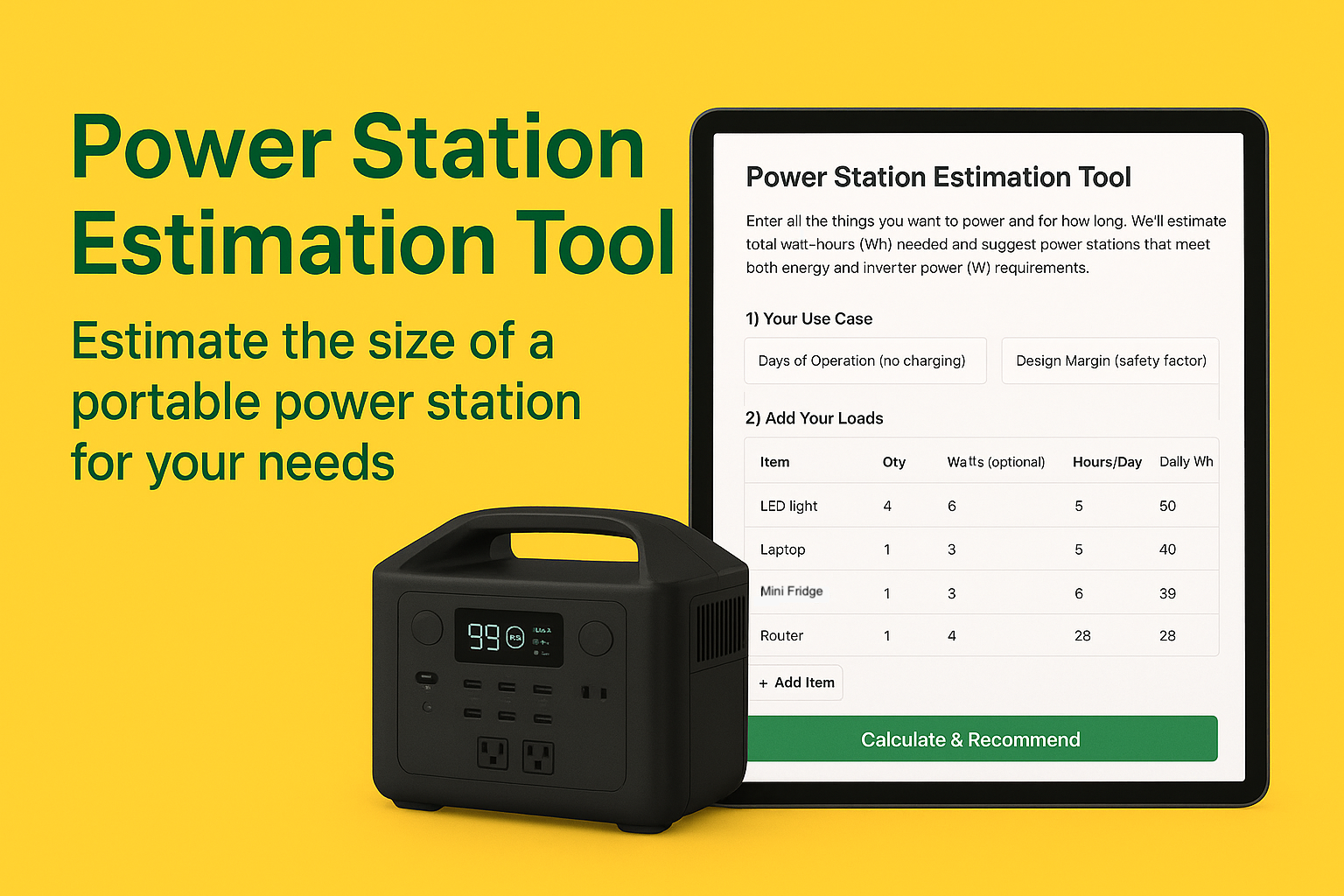
Use our free portable power station size calculator to estimate the battery capacity and inverter output needed for your appliances and electronics. Add the equipment you want to run, and the tool calculates daily watt-hours, peak wattage and an appropriate power-station size.
Evergreen Off-Grid just launched a free tool that takes the guesswork out of picking a portable power station. Tell it what you want to run—lights, laptop, mini fridge, router, CPAP, fans, even pumps—and it will estimate your daily energy (Wh), your peak load (W), and suggest power stations that actually fit your needs.
Whether you’re prepping for power outages, kitting out a camper, or planning an off-grid workstation, this makes sizing your power station simple.
What the calculator does (in 30 seconds)
Estimates watts automatically if you don’t know them (based on common devices and typical duty cycles).
Calculates Daily Wh, Estimated Peak W, and Required Battery Capacity for the number of days you choose.
Recommends popular units across brands like Jackery, EcoFlow, and Anker that meet both energy and inverter requirements.
Works great on mobile and desktop—no sign-in needed.
⚠️ Affiliate note: Product links are affiliate links. As an Amazon Associate, we may earn from qualifying purchases. Thank you for your support.
How it works
Set your days of autonomy (e.g., 1–3 days with no charging).
Choose a Design Margin (extra headroom for system losses and real-world use).
Add your loads: device name, quantity, hours/day. If you leave “Watts” blank, the tool will make a smart estimate for you.
Click Calculate & Recommend to see your system requirements and a short list of matching power stations.
What the key numbers mean
Daily Wh: The total energy your devices consume in a day.
Peak Load (W): An estimate of the highest power you’ll pull at once (useful for inverter sizing).
Required Capacity (Wh): What your battery should store, adjusted for typical conversion/usable-capacity losses plus your chosen safety margin.
A quick example
Let’s say you want to cover the basics for a day:
LED lights (4 LEDs, 5 hrs/day) → ~200 Wh
Laptop (1, 4 hrs/day) → ~240 Wh
Mini fridge (24 hrs/day, ~50% duty) → ~840 Wh
Wi-Fi router (24 hrs/day) → ~288 Wh
Daily total ≈ 1,568 Wh.
For 1 day, after accounting for typical inverter/battery losses and a +10% safety margin, the tool recommends a battery around 2,130 Wh.
Estimated peak power for these loads is modest (about ~200 W with margin), so most mid-size stations are fine on inverter power.
Want 2 days without recharging? Roughly 4,260 Wh required. The tool updates this instantly as you change days or loads.
Who this helps
Home backup: Keep essentials running during outages—lights, network, fridge, medical devices.
Van/RV & camping: Dial in a right-sized solution so you don’t overbuy or run short.
Remote workstations: Laptops, monitors, routers, and a fan—done.
Small tools & pumps: Check if surge/starting loads push you into a higher-power inverter.
Pro tips for better results
Nameplate is king: If your device lists watts (W) or volts × amps (V×A), type that in for best accuracy.
Duty cycles matter: Fridges, freezers, and ACs don’t run 24/7; the calculator already accounts for typical on/off behavior.
Think “what runs at the same time?” That’s what drives inverter wattage, especially with appliances that have high startup surges.
Use the Design Margin: +20–30% is conservative if you’re traveling or in cold climates, or if your loads are variable.
What the recommendations mean
When you hit Calculate, you’ll get a short list of portable power stations that meet both:
Your required battery capacity (Wh), and
Your minimum inverter power (W).
We keep this list fresh across a range of brands and sizes so you can compare options quickly.
Tip: If any device has a high surge (well pumps, power tools), prioritize a unit with adequate continuous W and strong surgecapability. Manufacturers list this in the specs.
FAQ
Do I need to know the wattage of every device?
No. If you leave watts blank, the calculator uses typical values. For uncommon gear, check the label or manual for best results.
Can I include solar charging?
This version sizes for a fixed number of days without charging. If you’ll add solar, you can lower “days” or use the results as a conservative baseline.
What about 12V DC devices?
You can enter them as well. If you’re running through the AC inverter, the tool already accounts for typical conversion losses.
Is this a wiring or code compliance tool?
No—this is a planning/estimation tool. Always follow manufacturer instructions and local codes for installation.
Privacy?
We don’t require any login to use the calculator.
Ready to try it?
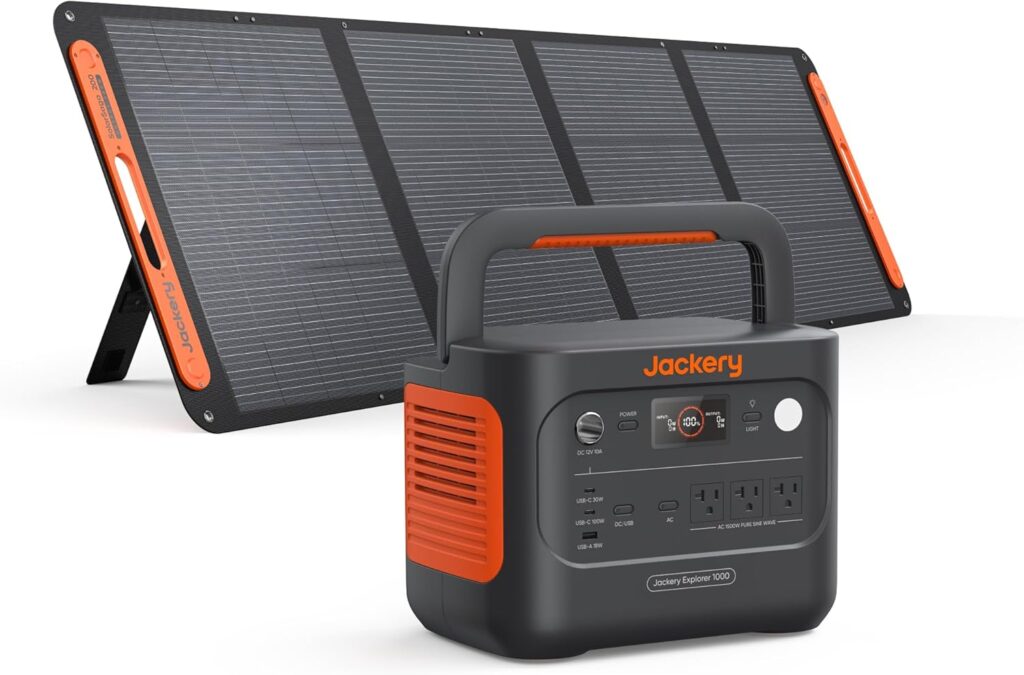
Jackery Solar Generator 1000 v2 with 200W Solar Panel,1070Wh Portable Power Station LiFePO4 Battery,1500W AC/100W USB-C Output
$1,299.00 Original price was: $1,299.00.$699.00Current price is: $699.00.
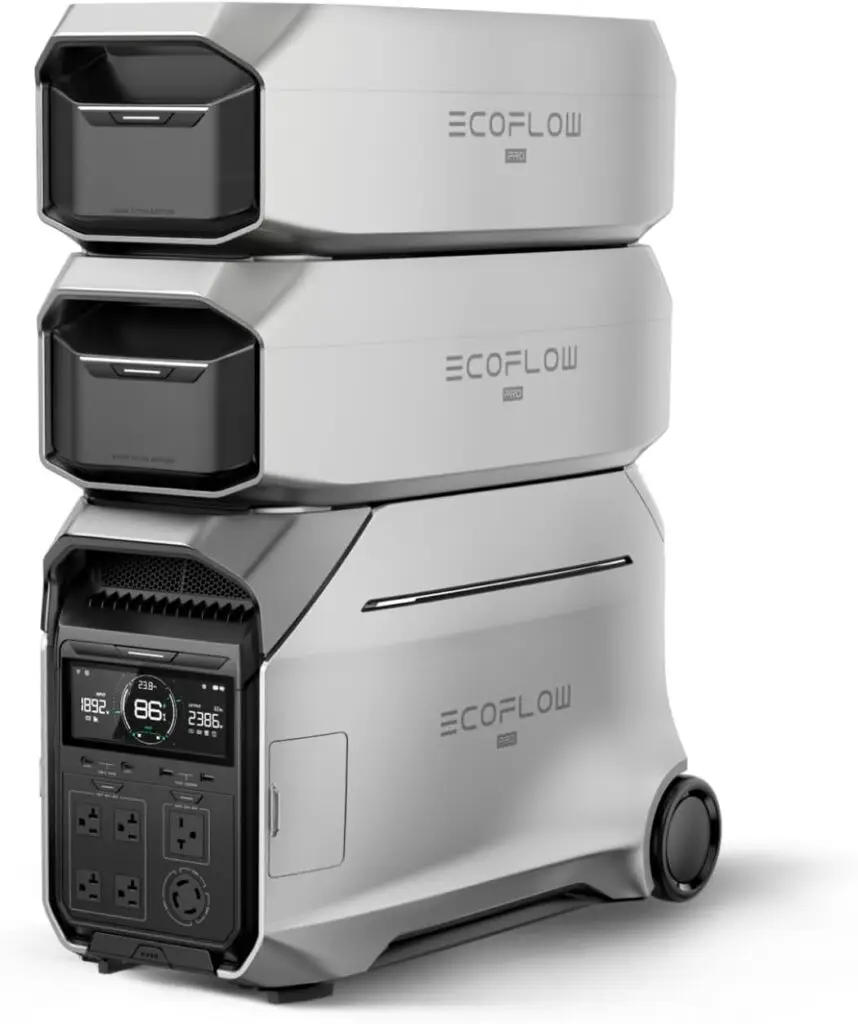
- 4000W Output (6000W with X-boost)
- 12kW Capacity
$9,599.00 Original price was: $9,599.00.$6,198.00Current price is: $6,198.00.
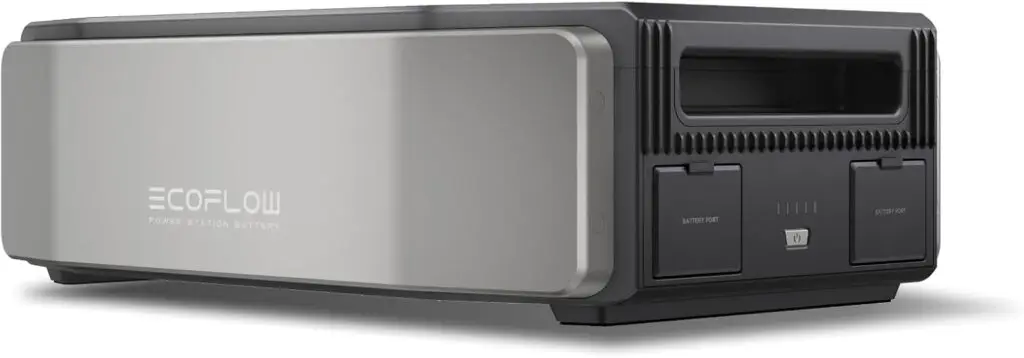
- 21kW Output!
- 90kWh Capacity!
$3,299.00 Original price was: $3,299.00.$2,299.00Current price is: $2,299.00.
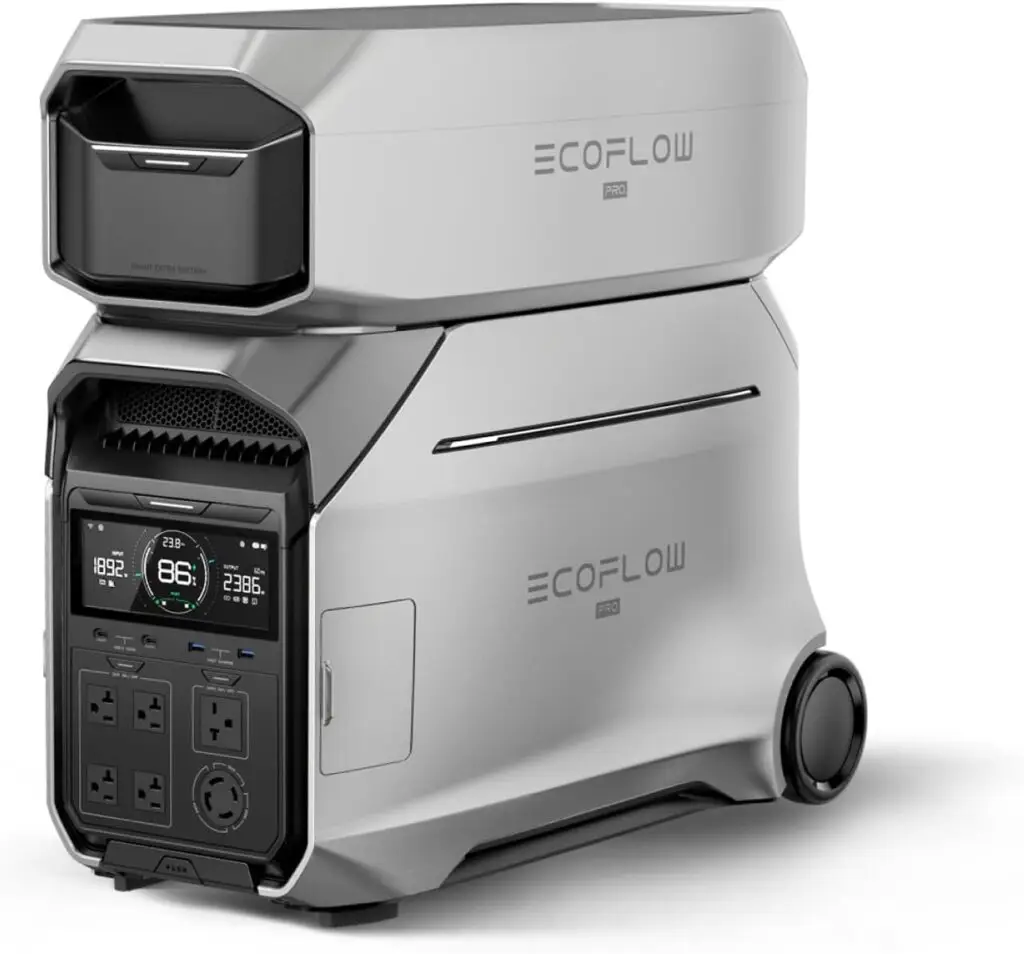
- 4000W Output
- 8000Wh Capacity
$6,298.00 Original price was: $6,298.00.$4,099.00Current price is: $4,099.00.
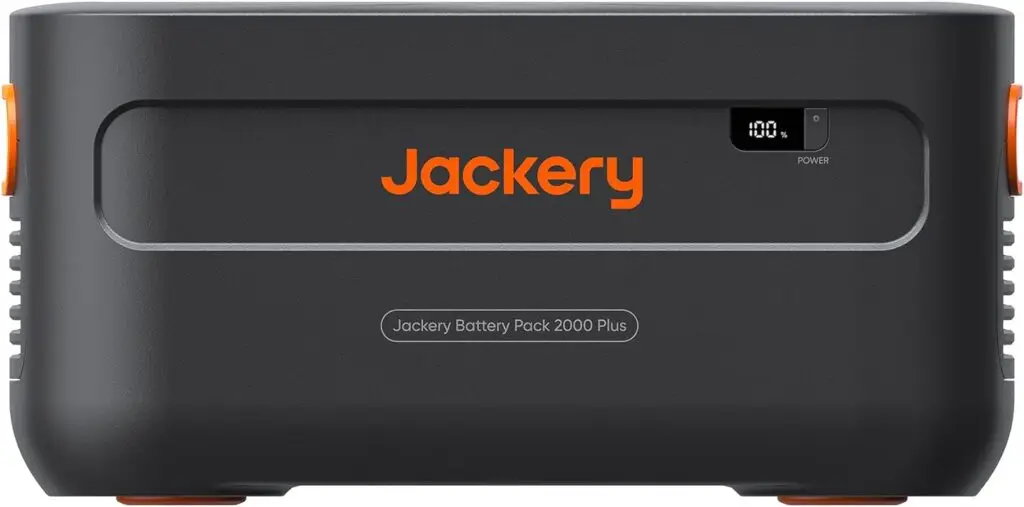
- 3000W Output
- Extra 2000 Wh Capacity
- Expandable up to 24 kWh!
$1,599.00 Original price was: $1,599.00.$929.00Current price is: $929.00.
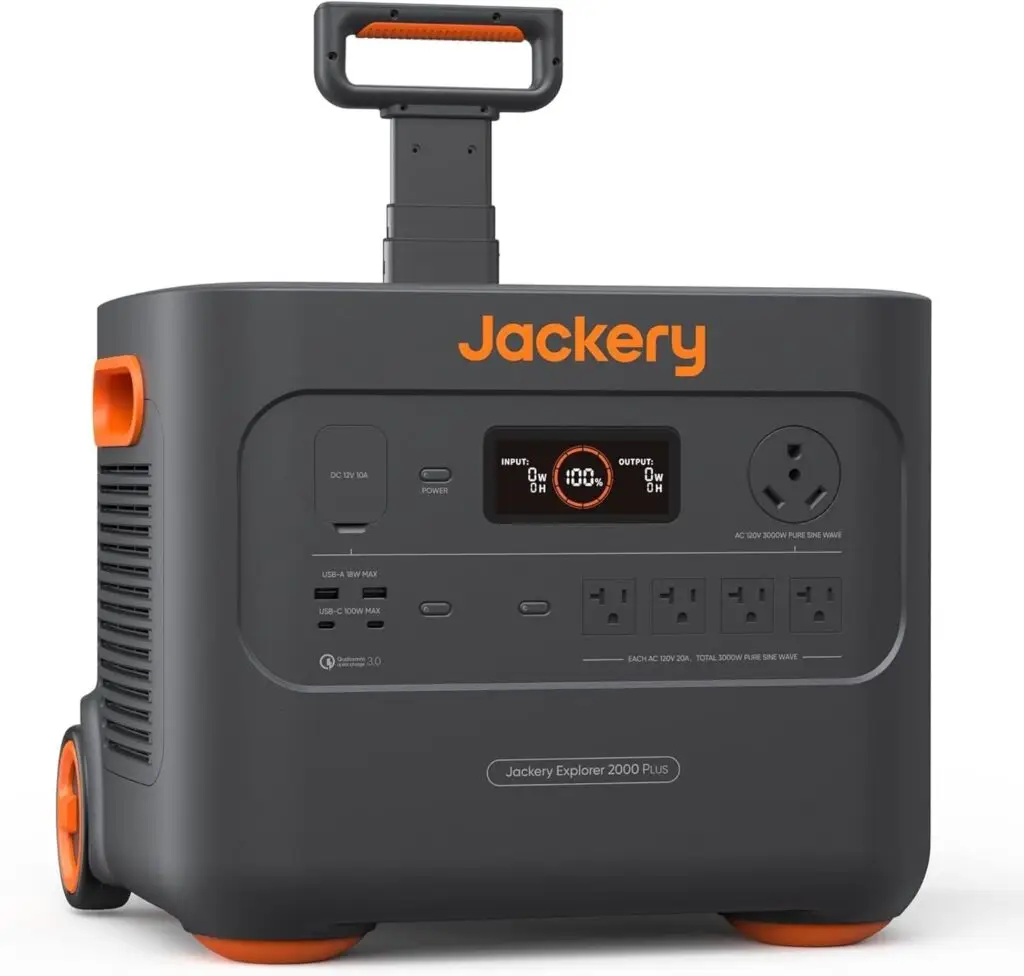
-
3000W Output
- 2,042.8 Wh Capacity
$1,999.00 Original price was: $1,999.00.$1,499.00Current price is: $1,499.00.